
The scissors come back from sharpening. They cut — but the stylist immediately notices: they no longer work the way they used to.
In slicing, they no longer glide through the hair as easily and smoothly. Hair starts being pushed toward the tips. More thumb pressure is needed to close the scissors.
And yet the cutting edge may still be sharp.
What has changed?
The geometry of the scissors may have been altered during sharpening.
Geometry is more than just the sharpening angle
With professional scissors, the cutting edge is only one part of the picture.
The way the scissors work is influenced by:
- the edge profile — Bevel, Semi-Convex or Convex;
- the sharpening angle;
- blade shape and curvature;
- the inner blade surfaces;
- the thickness of the blades and tips;
- how the two blades interact as the scissors close.
All of these elements work together as one system.
That is why sharpening is not simply about creating a sharp edge. The aim is to preserve the original geometry of the particular pair of scissors as closely as possible.
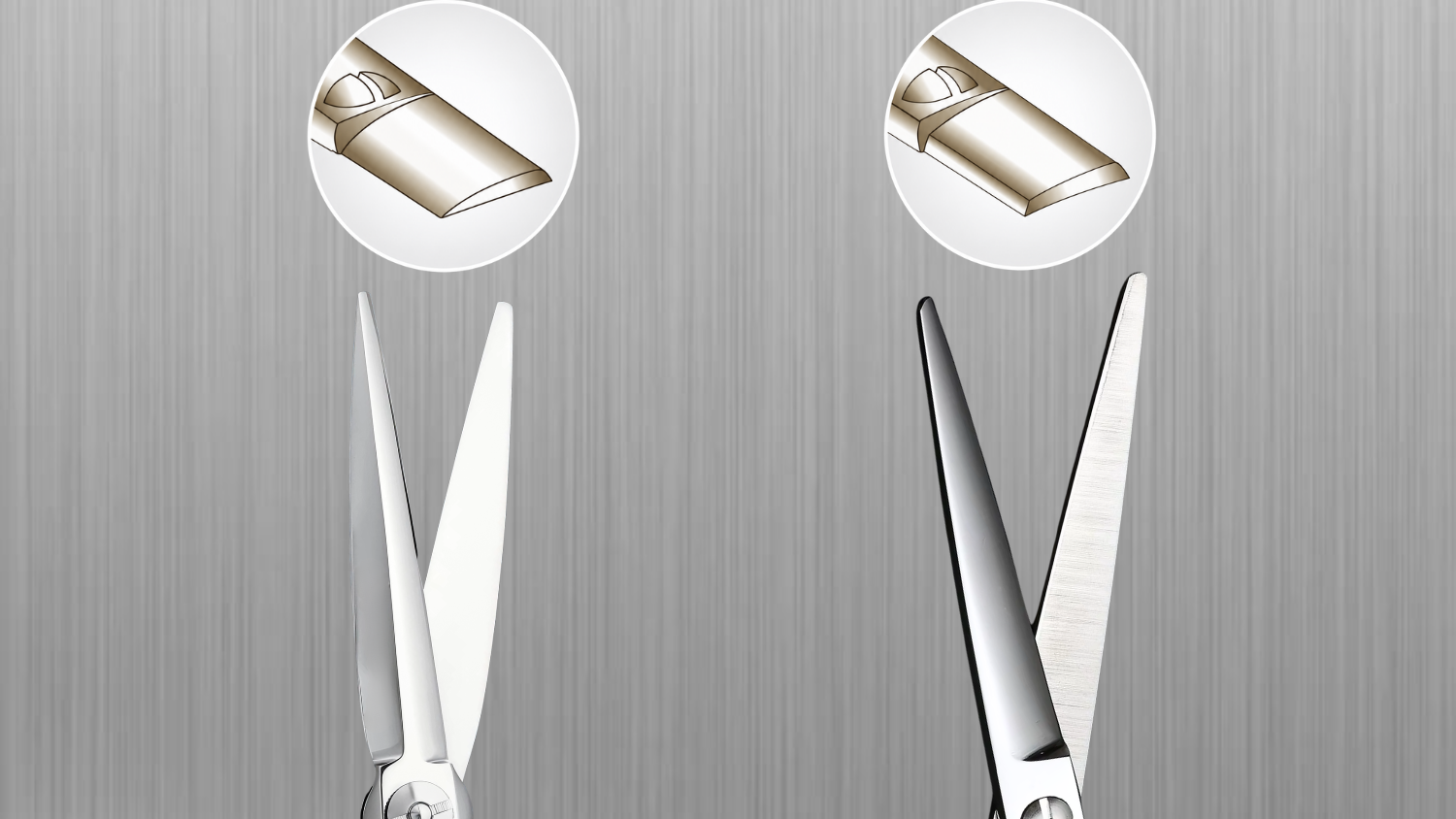
Left — Convex; right — Bevel: different edge geometry changes the way the scissors work.
Convex: sharp, but no longer the same
Imagine a pair of scissors with a Convex edge that a stylist normally uses for slicing.
Before sharpening, they cut softly and glided smoothly through the hair.
But during sharpening, the original Convex profile was significantly altered and a pronounced Bevel was created instead.
The cutting edge may still be extremely sharp.
But the way the scissors work has already changed.
In the familiar slicing technique, the scissors may no longer glide as smoothly, may behave differently as they move through the hair, and may require more force to close.
In practice, it can be very simple: the sliding cut no longer works as smoothly as before, while a regular straight cut still works.
The scissors have not become blunt — they simply no longer work the way they were designed to.
→ How to Choose Hairdressing Scissors: Bevel, Semi-Convex, and Convex Edge Types
So what is the correct angle?
There is no single “correct” sharpening angle for all hairdressing scissors.
Even two Convex scissors that look very similar may have different geometry.
If the original angle or edge profile is changed, the scissors may remain sharp but behave differently in the hair and require more effort to use.
A stylist often feels this immediately in the hand: familiar scissors suddenly require more thumb pressure to close, or the stylist may have to go over the same section more than once.
So the question during sharpening should not be:
“What angle should I sharpen this to?”
but rather:
“What angle and profile were these scissors designed to have?”
Proper sharpening should not make a stylist relearn how to work with a familiar tool.
It is also important to distinguish a real problem from the normal adjustment period after sharpening:
if the scissors suddenly feel easier to work with, that can be normal. If they are noticeably harder to work with, it is worth having them checked.
→ Do the scissors feel different after sharpening — or is something actually wrong?
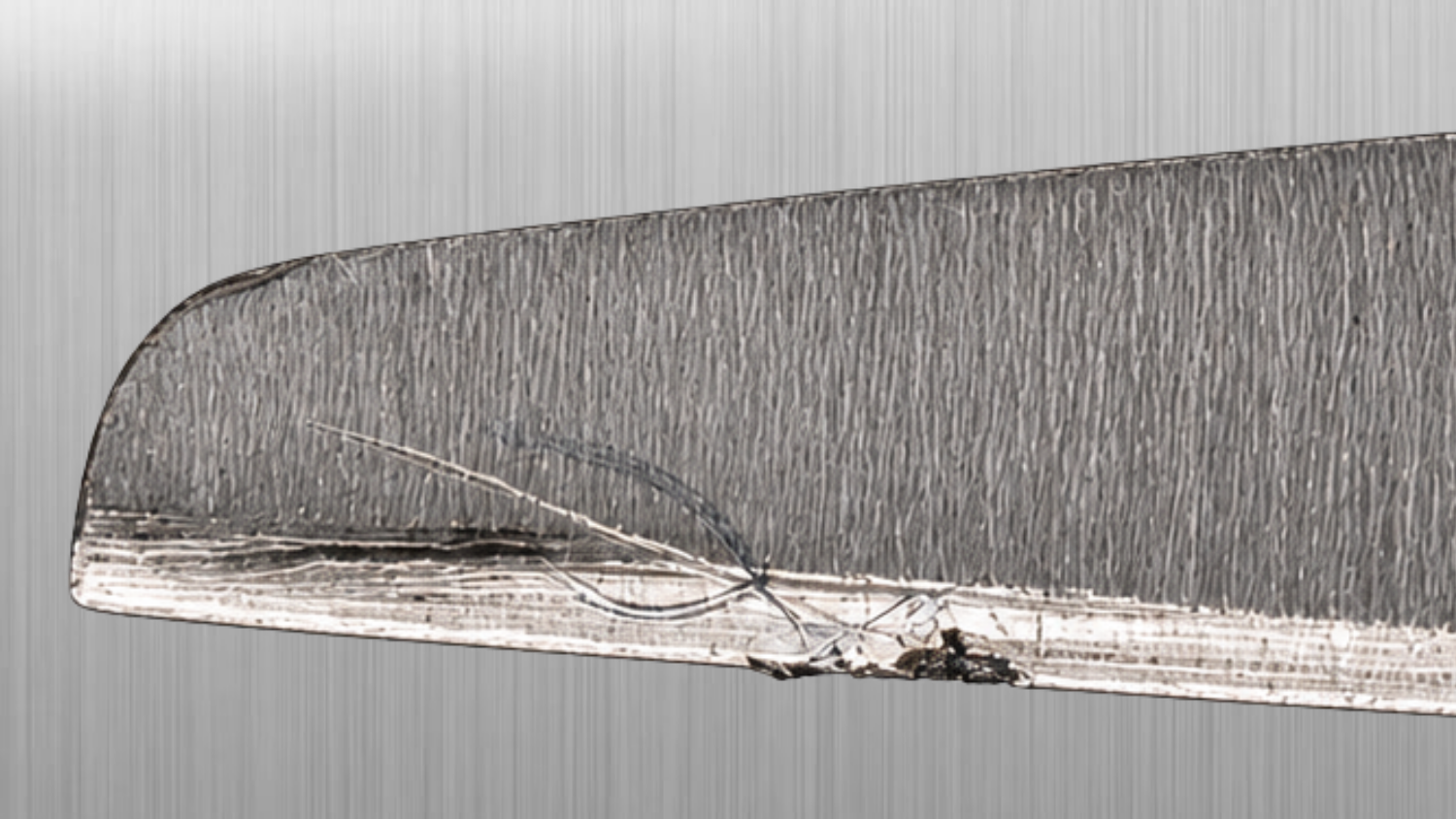
Local edge defect: even a small amount of damage can noticeably change how the scissors work.
“Let’s remove more metal — then they’ll definitely be sharp”
A small defect on the cutting edge does not mean that more metal should be removed than necessary.
→ A small chip on the cutting edge: why a tiny defect changes how scissors work
The aim of sharpening is to remove the damage while preserving the blade shape and working life as much as possible.
The tips are particularly sensitive. Small problems with the cutting edge, tip shape or blade contact often become noticeable there before they do along the main part of the blade.
→ Hairdressing scissors no longer cut at the tips: why does the problem often show up there first?
If the main part of the blade still cuts well but the tips already bend the hair or fail to cut it cleanly, the answer is not always to “sharpen the tips more.”
The condition of the cutting edge, the shape of the tips and the way the two blades work together all need to be checked.
That is why the principle “the more metal removed, the better the sharpening” does not work here.
The more precise the work and the less unnecessary metal is removed, the more of the scissors’ working life can be preserved.
→ How many times can hairdressing scissors be sharpened, and why is there no single number?
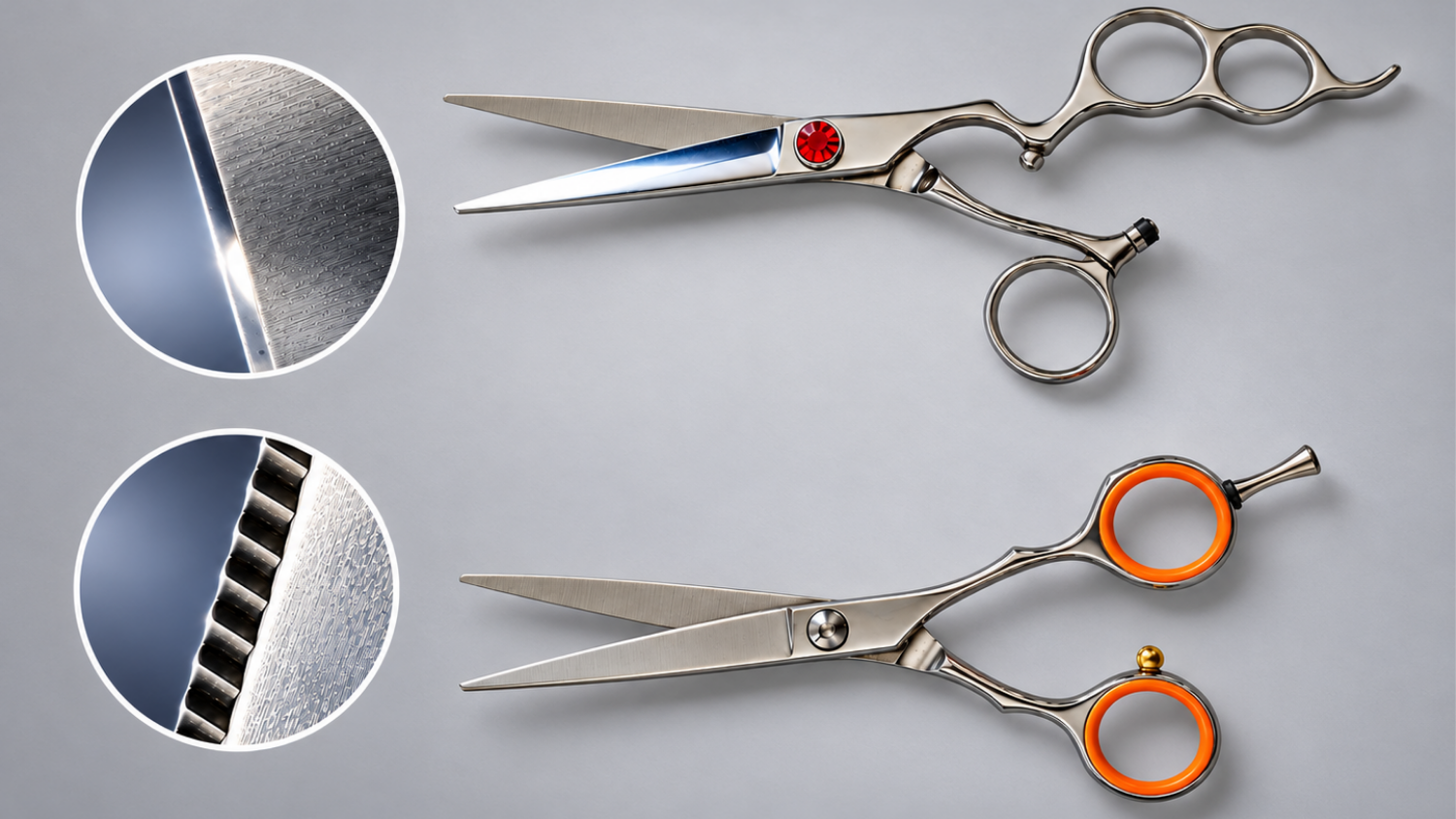
Top — a smooth cutting edge for freer sliding;
bottom — micro-serration for holding the hair in place.
Why do some scissors hold the hair while others let it slide?
Because the geometry and cutting-edge treatment are different.
A straighter blade helps keep the hair in the cutting zone, while micro-serration further reduces slipping.
A more pronounced blade curve and a smooth edge, on the other hand, can make sliding easier — exactly what is needed for slicing and slide cutting.
That is why two equally sharp pairs of scissors can behave completely differently in the same section of hair.
→ Why do some scissors hold the hair while others let it slide?
This is how geometry changes the character of the cut.
Both blades have to work together
Scissor geometry does not end at the visible cutting edge.
What also matters is how the two blades interact with each other from the base all the way to the tips.
If that interaction is disturbed, sharpness alone is not enough.
→ What Is Included in Professional Hairdressing Scissors Sharpening?
Sharp does not automatically mean properly sharpened
After sharpening, it is not enough for the scissors simply to cut again.
What matters is preserving the way they were designed to work.
A Convex profile should not unexpectedly turn into a different profile.
Scissors designed for sliding techniques should not lose their familiar smooth glide.
A tool designed to control the hair should not start pushing it forward.
And metal that determines the future working life of the tool should not be removed simply to achieve instant sharpness.
Proper sharpening restores sharpness while preserving the geometry and working characteristics of the scissors.
📚 → All articles about sharpening, restoration and professional tools
✂️ → ZATOCHKA.LV — preserving the geometry and working life of your tools.