
The scissors may remain sharp along almost the entire cutting edge, yet start catching or pulling hair in one particular spot. Sometimes the cause is a small local defect on the cutting edge.
Sometimes a small chip is almost impossible to see without magnification.
But the stylist can already feel the difference: the scissors cut differently.
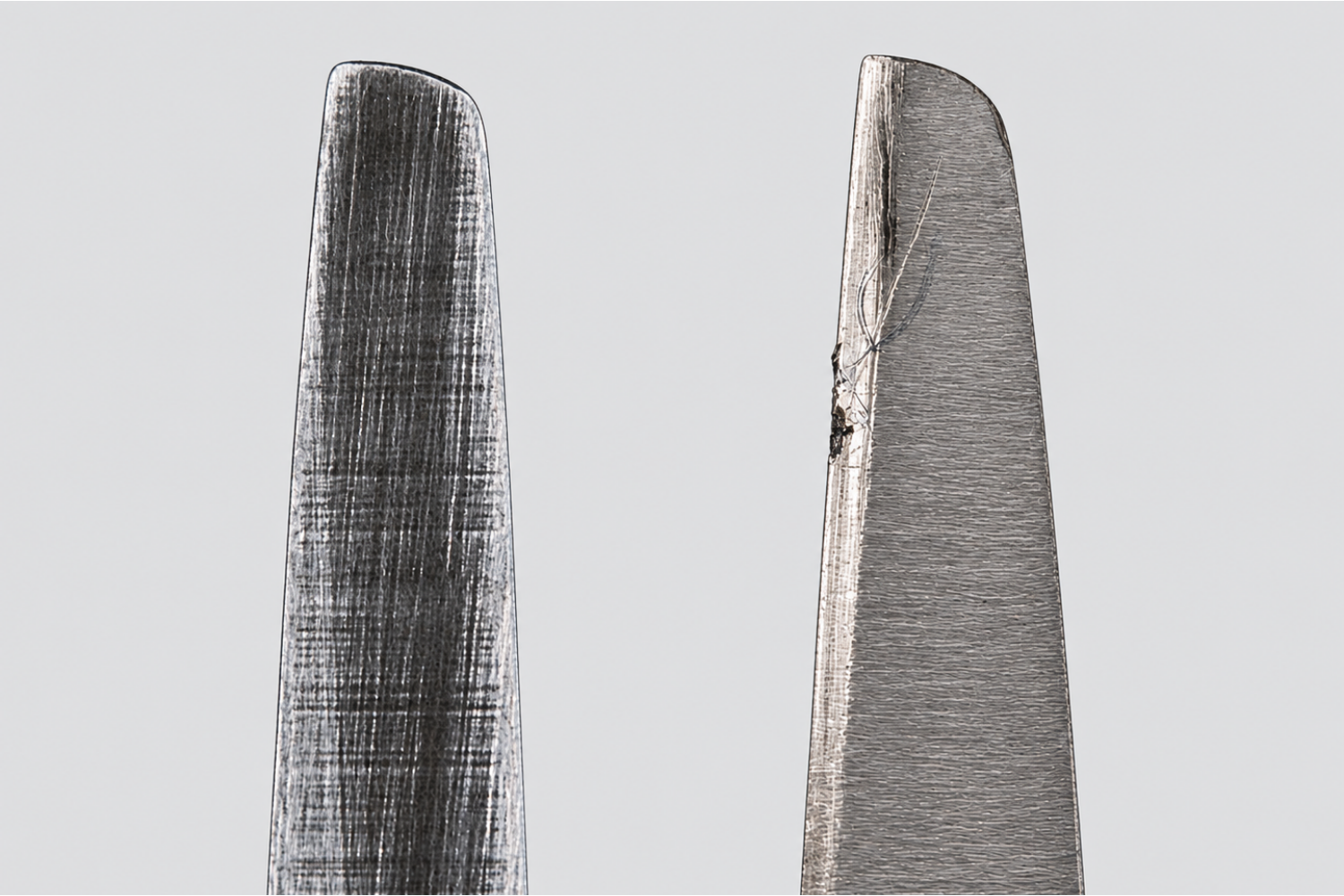
wear | local chip
Not simply dull — they catch in one spot
With normal wear, sharpness gradually decreases along the working length of the cutting edge.
A tiny chip is different: most of the edge may still be sharp, while the problem is concentrated in one small area.
The scissors may still cut normally overall, but at one particular point they:
- catch the hair;
- pull slightly;
- bend the hair between the blades instead of cutting cleanly;
- feel unusually resistant when closing.
Sometimes the feeling is best described simply as:
“The scissors are sharp, but something is getting in the way.”
How does a tiny chip form?
Common causes include:
- dropping the scissors;
- an impact to the cutting edge;
- contact with a metal comb, hair clip or another hard object;
- damage caused by improper sharpening.
The defect may be so small that the cutting edge looks perfectly normal at first glance.
→ Dropped your scissors? What to do and whether they can be restored
Why it is better not to keep working
If the scissors repeatedly catch in the same place, do not try to compensate by squeezing the handles harder.
Each time the blades close, the damaged area comes into contact with the opposite blade again. A small defect can become worse or damage the opposite cutting edge as well.
The more serious the damage, the more metal may need to be removed during restoration.
→ How many times can hairdressing scissors be sharpened: why there is no single number
Can you see a tiny chip without magnification?
Sometimes a larger chip can be seen in good light as a small irregularity in the cutting edge.
But a very small defect may be practically invisible.
That is why it is more important to pay attention to how the scissors behave:
- they catch in the same place;
- you feel resistance when closing them;
- they start pulling or bending the hair;
- you have to repeat the cut.
These signs do not always mean there is a chip. Incorrect tension adjustment, dirt or poor blade contact can cause similar symptoms.
A professional inspection can identify the exact cause.
The main point
A small defect does not always mean a small problem.
If the damage is located in the working area of the cutting edge, it affects the scissors every time the blades close.
The earlier it is detected, the less metal usually needs to be removed during restoration — and the more of the scissors’ working life can be preserved.
→ ZATOCHKA.LV — inspection and professional sharpening of hairdressing scissors.